 Aiden C. Eckert
Nucor Steel West Virginia
This summer, I was fortunate to have the opportunity to return to Nucor Steel West Virginia for a second summer internship. This was my fourth summer with Nucor, beginning at Nucor Steel South Carolina and continuing with an opportunity at Nucor Steel Auburn before spending the past two summers at Nucor Steel West Virginia. Each experience has given me a different perspective on the steel industry, but the past two summers have been especially unique because I had the opportunity to take part in building a new steel mill and see the process of bringing it toward operation.
In the fall, I will be entering my final semester at Michigan Technological University studying mechanical engineering with a minor in manufacturing. I have always enjoyed learning about manufacturing and seeing how the different parts of a manufacturing process work together. My education at Michigan Tech has given me a strong foundation in mechanical engineering and manufacturing, and my internships with Nucor have allowed me to apply that knowledge to real-world equipment and processes.
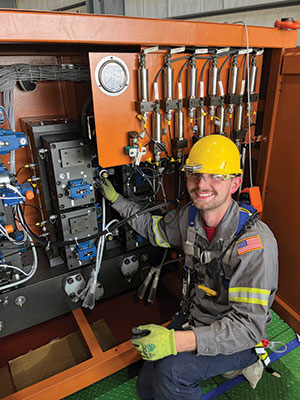 During my internship, I had the opportunity to work with an amazing team while continuing to develop my technical and hands-on skills. One of the most unique aspects of working at Nucor Steel West Virginia was being able to work with equipment before the mill began production. I was able to help with unpacking, inspecting, installing and preparing new equipment for operation. Being able to work around equipment before the mill was running allowed me to see components and systems in a way that would not be possible in an operating mill.
One area where I gained valuable experience was working with the hydraulic systems throughout the mill. I worked with another intern to get the reject table ready for commissioning of the caster, which required us to set up a temporary hydraulic power unit. This presented a practical challenge because we had to connect the temporary HPU to the existing hydraulic cylinders using a combination of different fitting types. We had to determine how to adapt smaller ORB connections into JIC connections and then into Code 61 flange connections. We worked with vendors to identify the appropriate adapters and fittings and incorporate them into the temporary system. This experience gave me a better understanding of hydraulic components and connections while also teaching me how to work through an unfamiliar problem, communicate with vendors, and develop a solution as a team. Getting the reject table ready for commissioning also gave me the opportunity to see how individual mechanical and hydraulic components come together into a larger system and how equipment must be prepared before it can safely and reliably operate. I also participated in flushing the mill’s water systems used for cooling, helping prepare the systems by removing debris and contaminants before operation. This gave me a better understanding of the importance of preparing supporting systems before full commissioning and how seemingly separate systems are critical to the operation of the mill.
In addition to working directly with equipment, I was able to apply my engineering skills to design projects. I designed a mandrel puller for the down coilers, which gave me an opportunity to work through a practical engineering problem from the design stage toward a usable solution. I also designed a steel storage rack to help organize and store material within the mill. These projects allowed me to apply concepts from my mechanical engineering and manufacturing coursework while also considering the practical requirements of equipment used in an industrial environment. Working on these projects reinforced for me how important it is for an engineer to consider not only whether a design will work, but also how it will be used, installed, and maintained.
Over the summer, I also had the opportunity to participate in multiple training classes and an intern summit. I attended a hot roll theory class, where I deepened my understanding of the sheet hot mill and how the process works through the equipment, adjustments, and controls. I also attended a gearing school where our supplier taught us about different types of gears, gear design, gearbox types, and the proper adjustment and setting of gears. These classes helped me better understand the equipment I was working with and gave me knowledge that I could apply directly to the mill and projects at school.
Another highlight was attending an intern summit with interns from across Nucor. We learned about the different divisions and product groups within the company and how they contribute to the larger steel industry. We learned how the sheet group supports automotive manufacturing and had the opportunity to tour the Ford Rouge assembly line. We also learned about Nucor's scrap process, structural manufacturing divisions, Universal Industrial Gas, and bar products. Seeing these different parts of the company helped me better understand the scale of Nucor and how the different divisions work together to supply steel to a wide range of industries.
I am thankful for all the teammates who took the time to teach me and involve me in their work throughout the summer. The hands-on experience I gained with hydraulic systems, cooling systems, equipment installation, and engineering design has helped me grow as an engineer and given me a better understanding of what it takes to build and operate a modern steel mill. I appreciate the investment that Nucor and AIST have made in me as a young engineer entering the steel industry. These experiences have not only helped me grow as an engineer but have also confirmed my interest in working in the steel industry. After four summers of internships with Nucor, I am excited to announce that I will be returning to the hot mill department at Nucor Steel West Virginia after I graduate. I look forward to continuing to learn, contribute to the team, and build on the experiences I have gained through my internships.