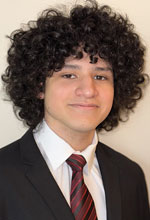
 Carlos A. Lazo
SSAB Research & Development Center
I had the amazing opportunity to work at SSAB Research & Development Center in Montpelier, Iowa, USA, this summer. At their Montpelier mill, SSAB uses electric arc furnaces to melt recycled scrap. The liquid steel is subsequently refined in the ladle where it is trimmed with ferroalloys and alloying elements to tailor the steel chemistry to the intended application. Further refining can be carried out in a vacuum tank degasser to lower the contents of hydrogen and nitrogen. After degassing, the ladle with the liquid steel is sent to the caster, where it is continuously cast into slabs. The slabs are then reheated in the reheat furnace, after which they are delivered to the rolling mill where they undergo thermo-mechanical deformation to the final gauges. SSAB Americas serves many industrial sections, including energy, construction, agriculture, heavy equipment and transportation.
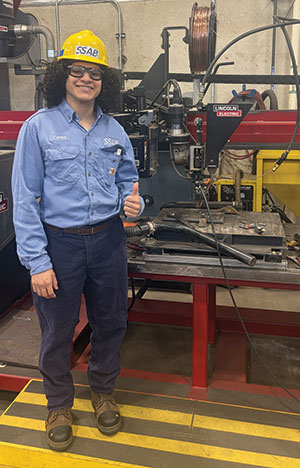 My project focused on the production of chromium carbide overlays (CCOs), which is an Fe-C-Cr wear-resistant material that is overlayed on steels for applications where abrasion resistance is critical. This is particularly vital in the oil sands, concrete, cement, and mining industries. CCOs can be welded onto a steel plate through an open arc welding process utilizing a chromium- and carbon-rich welding consumable. When the consumable is deposited onto the steel, it creates a fusion zone whose composition is a mixture between the base material and welding consumable. The exact composition is dependent on welding parameters, such as heat input, that determine the amount of base material that is melted and mixed into the fusion zone. This is referred to as dilution. Dilution causes a reduction in the fraction of carbides that form in the fusion zone. Since CCOs rely on carbide formation for abrasion resistance, a reduction in the fraction of carbides also reduces hardness and wear resistance. My project involves the development of a new welding process to produce CCOs. This new welding process should reduce dilution, increase the fraction of carbides and hardness, and achieve a greater wear resistance than traditional CCO products.
To achieve this, I worked closely with my mentor, Dr. Alejandro Alvarez, and research analyst, Wyatt Gentz, in SSAB R&D’s welding lab, running trials with new welding equipment and parameters. Welding trials were performed utilizing a welding thermal-imaging camera for in-situ arc monitoring and process development. I would then section, mount, and polish sections from a limited number of welds to perform light optical microscopy, scanning electron microscopy with energy-dispersive spectroscopy, and microhardness Vickers testing to determine dilution, examine compositional and microstructural gradients, and quantify the primary carbide fraction in the overlay. Using these metrics, I could see the effects of the parameters we changed in the lab. For example, higher heat input can lead to better fusion to the base material, but causes more dilution in the fusion zone, thereby decreasing its wear-resistance. This part of my internship bridged the gap between my theoretical knowledge of metallurgy, and the actual practice of it. I also gained considerable experience in process design, which is something I’m fascinated by, but have not been able to practice much in my classes.
Although I have a strong background in material sciences, there was still much for me to learn at SSAB. Working in an industrial setting is entirely new to me, and I think that SSAB was a great introduction to that. I learned the importance of thoroughly planning experiments, working with the schedules of different analysts, and meeting internal deadlines. The weekly reports were particularly impactful on me, since they let me see the scope of the fellow engineer’s projects, while also providing an opportunity for me to practice my ability to communicate my progress to someone who may not be familiar with my project. Writing these reports helped refine my metallurgical knowledge, as I had to read welding literature to explain the phenomena I was observing. These reports were some of my favorite parts at SSAB, since they gave a glimpse into what my future as an engineer would look like. Juggling multiple projects under different deadlines, working closely with a team of analysts, and keeping organized even through all that! Seeing the scale of the work was also inspiring, as you can directly see the impact these engineers are making on the company, whether through the development of new products or improvement of existing products. Seeing the vast applications of these products, whether for mining, infrastructure, or other industries, made me see how my work directly benefits society.
I’ve loved working at SSAB, not just for opening my eyes to research and development activities in industry, but for the sense of community. SSAB runs a tight ship, so I quickly became familiar with everyone in the department, which made it much easier to work with them. The strong safety-first culture also promotes everyone to look out for each other, which was very reassuring. I enjoyed hearing people’s safety stories, which promote caution in both professional and personal settings, while also helping learn more about the team. I will always be grateful to SSAB and AIST for providing this opportunity for me to not only improve my existing skills, but to expand to new skills that can only be learned through hands-on experience in the industry. The support from the team has been amazing, and through this experience my passion for metallurgy and my knowledge of it has grown tremendously!