 Haden A. Smith
Steel Dynamics Inc. - Butler
This summer, I was given the opportunity to return to Steel Dynamics Inc. – Flat Roll Group Butler Division for another mechanical engineering internship. Building upon a solid foundation that was established last summer, I was eager to contribute to more meaningful projects, expand my operational knowledge of continuous steel processing and take on more responsibilities. My main project this summer was to help eliminate waste and improve efficiency in chemical usage for the cleaning section on one of our galvanizing lines.
Toward the beginning of my internship, I was approached with an operational inefficiency: we were consuming too much caustic in our cleaning section. Based on data from vendors supplying the materials and sister plants running similar processes, we found that we were spending substantially more than was theoretically needed. So, I immersed myself in the process, attempting to understand how the cleaning section functioned, in order to find areas where there was either waste or inefficiencies. I worked daily with my supervisor and operators on the line to deepen my understanding, eventually running tests to gather data on water and caustic usage. During this stage, I was able to strengthen my problem-solving abilities as well as data collection and data analysis. After performing this analysis, we found that we were dumping thousands of gallons per day of perfectly good caustic water down the drain because of the cumulative purge cycles of our primary filtration system.
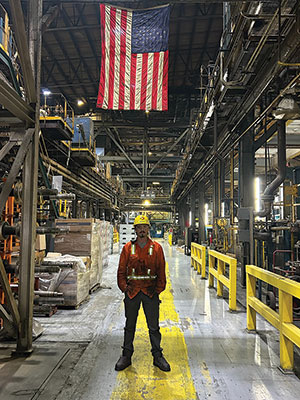 I began developing a secondary, off-line tank that the water could be pumped into to filter mechanically, for when our “in-process” filter was not able to support the amount of water we were sending it. I began with designing a two-stage tank incorporating a weir wall that was able to mechanically settle suspended iron particles, or iron fines, from the water so that the water could be then pumped back up into process. I was then approached by my supervisor about an old filtration tank that was commissioned on our other galvanizing line for a different purpose, but never used, and decided to incorporate that as the “dirty tank” to save on fabrication and material cost, while designing a separate “clean tank” that we would pump out of.
I was then able to coordinate with vendors, fabricators and on-site contractors daily to go over the process, equipment layout, installation and modifications. While fabrication of the clean tank was going on, I was having the dirty tank relocated and appropriate modifications were being made.
After having everything installed, toward the end of my internship, field testing validated our analysis. We were pushing thousands of gallons a day through the new off-line tank, which in turn is projected to result in roughly US$200,000 in annual caustic savings at current caustic rates, while also reducing the burden on our plant’s RO system by roughly 2.5 million gallons a year.
Seeing the tangible impacts such a seemingly small project could have on savings and process efficiency was incredibly satisfying. Managing this initiative from initial data gathering to final contractor coordination allowed me to strengthen many of my technical skills, as well as my project management, problem-solving and effective communication skills.
I am very thankful for the opportunities Steel Dynamics has provided me with, allowing me to work on meaningful projects, grow as an engineer and learn more about the steel
industry, with genuine mentorship. I also would like to thank AIST for their support of students, both financially and practically supporting careers in the steel industry. It is opportunities such as this that have helped solidify my commitment to continue in the steel industry upon graduation.