
 Joshua Nelson
Donsco Inc.
I had the opportunity this summer to intern with Donsco Inc. as an engineering intern. This experience helped to broaden my understanding that manufacturing is not simply a
sequence of independent operations, but a highly connected system. A system of people, machines, instrumentation, data and more! Every part represents the combined efforts of production, machining, quality, maintenance, engineering and countless decisions made throughout the manufacturing process. My internship started with a deep assessment of the process, interpersonal relational function, manufacturing, solution feasibility and limiting constraints. The basis of my contributions involved more than what is at first sight, it was looking beyond surface level, understanding how information, people and processes work together to produce a beneficial result. I positioned my efforts around the understanding that as the summer ends, my designs will allow the products to succeed past my end date. I found balance to be the key as I had to weigh expectations and gather insights while driving forward my assessment and vision for solutions.
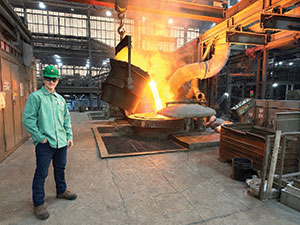 One of my primary responsibilities involved building the start of improvements needed at the Donsco machine shop. Initially, the project was aimed at creating a production dashboard, but the real value came in exposing the discrepancies in production data.
These insights will drive future improvements to the machine shop. The solution was a layered suite containing executive data function, supervisor cell management, then the initial demand of a production dashboard. I realized the depth of the challenge needed a solution that was different than the initial demand. Through my commitment to both the project and the work that I produced, my goal was to push forward this functional app to assist with need in operations. Production information originated from multiple manufacturing and business systems, and it also involved layers in data connectivity, SQL server management, programming and database connection. Before designing, I investigated the potential gap in data through a comparison of the data and production floor activity. I observed a difference; this is where my mindset shifted, allowing this project to expose necessary improvements in operations on the shop floor while providing an adaptable solution. In other words, this functional app will improve operational visibility and provide supervisors and management with information they can confidently use to support daily decision-making for continuous improvement.
Another project I took on this summer was investigating a product issue; a part in heat treatment that was experiencing unexpected growth. Inconsistent growth can be a downstream effect of process variance within manufacturing. To tackle this issue, I had to prove that the process was within statistical control. I was quickly driven forward in engineering investigations that required integrating production, quality and metallurgical data to leverage data analytics to understand manufacturing variation. Rather than searching for a single cause of variable growth, these investigations emphasized a structured engineering process: collecting evidence, validating assumptions, identifying patterns and understanding how multiple part-related factors interacted. This experience was not only useful as it gave Donsco confidence when ruling that the manufacturing process was within statistical control, but it was also a great challenge that required creativity around acquiring data, linking data and validating data. It provided a chance to practice data mining in conjunction with process control through data analytics.
These projects also demonstrated the importance of data integrity. Even the most sophisticated analyses are only as valuable as the quality of the information behind them. Supporting improvements to manufacturing are backed in the data connections and reporting systems. Building toward a larger goal was not simply an information technology exercise; it was an effort aimed at being the foundation upon which future process improvements can be made.
Perhaps the most valuable lesson reinforcing my previous experience was from the people around me. The engineers, supervisor, machinist, quality specialist and operator contributed knowledge that no data set could provide. They explained not only how processes worked, but what had evolved through years of practical experience. They willingly involved me right away in these processes. Their willingness to answer questions and share their perspectives truly shows that successful engineering depends as much on collaboration and curiosity as it does on technical ability.
This experience also strengthened my appreciation for industrial engineering. I found myself continually stepping back from individual problems to understand the larger system they belonged to. Meaningful improvements come from understanding how an entire operation functions.
I am grateful to everyone at Donsco who invested their time in my development and trusted me with this position. I am equally thankful to the AIST Foundation for making experiences like this possible. This internship and previous experiences have truly shown me that I am a visionary first and an engineer second. I strengthened both my technical skills and my confidence as a developing engineer, while supporting my excitement for a career in the iron and steel industry.