 Thomas D. Emery
Finkl Steel
My summer internship at Finkl Steel in Chicago, Ill., USA, was one of the most unique and educational experiences of my life. Since Finkl Steel is one of the world’s leading suppliers of forging die steels, plastic mold steels, die casting tool steels and custom open-die forgings, I was able to get a deeper insight into a more specialized side of steelmaking.
At the start of my internship, I was first introduced to the group of interns that would be working throughout the rest of the mill. I was also introduced to the team I would be working with, which was at the melt shop. The melt shop essentially takes a collection of different types of controlled scrap metals and melts them using the electric arc furnace. Once ready, the liquid steel is transported to the pits, where the setup for bottom pouring the steel into the molds is.
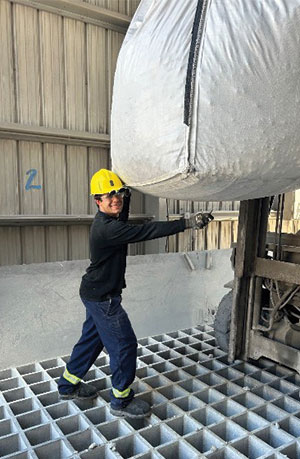 Next, I was informed of the roles I would have and tasks I would complete throughout my internship. These included ensuring safety, basic mill tasks such asdropping alloys into hoppers, identifying and marking types of scrap located around the shop, and improving efficiency of new employees by creating the online orientations of different job roles. On top of that, I became familiar with the use of larger industrial vehicles such as becoming forklift certified and driving a large dump truck around the plant to move scrap. Also, throughout this time, I gained valuable skills in Microsoft Excel, where I transformed the inventory usage matrix improving its accuracy and enabling decisions to be made quicker.
Alongside these personal projects, two metallurgy interns and I completed additional projects as a team. Our first project was to design and build mold covers for long 40-in. and 31-in. diameter ingot molds, which were prone to macro inclusions. For this project, we cut a flat thin sheet of steel and cut space for a mesh viewing window and attached handles to the top of it. The mold cover’s functionality was very successful and continued to be improved since the first initial test. Our second project was to improve quality and cost savings by creating an ingot box for ingots to be able to be cooled slowly if needed. For this, we decided to take old metal containers that were previously used for this and clean them out. We then replaced the refractory wool and screwed it into all sides of the inside of the box. This project is yet to be tested fully, but during rudimentary testing it worked perfectly.
Overall, working at Finkl Steel provided me with many interesting skills and projects that I am sure to carry into my future in the steel industry. I never would have expected to learn as much as I did, nor do the amount of valuable hands-on work I was exposed to. I am very thankful for Fink Steel and those who helped me with this opportunity, as it truly was a great introduction to working in an industrial environment.